







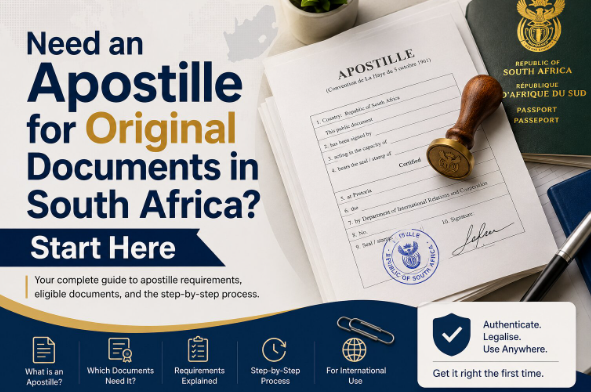
When you need to use a South African document in another country, you may be asked to have it authenticated before it can be accepted. For countries that recognise the Hague Apostille Convention, an apostille for original documents can simplify this process by confirming the authenticity of the signature, seal, or stamp on a public document.
Whether you are preparing documents for a visa, overseas employment, education, marriage, residency, or business purposes, understanding how document apostille works can help you avoid unnecessary delays.
Key Takeaways
- An apostille authenticates the signature, seal, or stamp on an eligible South African public document for use in participating foreign countries.
- Before you apostille original documents, confirm whether the original, certified copy, or notarised version is required.
- Check whether your destination country accepts an apostille or requires a different document legalisation process.
- Visa, employment, education, marriage, and residency applications may require apostilled documents depending on the destination and authority.
- If the process is unclear, a professional visa agency South Africa can help you understand document and visa requirements.
What Is an Apostille?
An apostille is a certificate attached to or placed on a public document to authenticate it for use in another country that is part of the Hague Apostille Convention.
It does not confirm that the information contained in the document is true. Instead, the apostille generally verifies the authenticity of the signature, the capacity in which the person signing the document acted, and the identity of the seal or stamp where applicable.
For South African documents, the appropriate authentication process depends on the type of document and the country where it will be used.
What Does “Apostille Original Documents” Mean?
The phrase apostille original documents generally refers to obtaining an apostille for an original public document or an eligible certified copy, depending on the requirements of the issuing and receiving authorities.
Not every document can simply be sent for apostille certification. Some documents may first need to be certified, notarised, or otherwise prepared before authentication.
For example, private documents may require notarisation before they can qualify for an apostille. The exact procedure depends on the nature of the document.
This is why it is important to determine the document category before starting the process.
Which South African Documents May Need an Apostille?
People may require apostilles for a wide range of documents when dealing with foreign authorities. Examples can include:
- Birth certificates
- Marriage certificates
- Police Clearance Certificates
- Educational certificates
- University degrees
- Diplomas
- Affidavits
- Powers of attorney
- Court documents
- Certain business or commercial documents
- Notarial documents
The requirements can differ depending on the document and destination country. An organisation receiving your documents may also have its own requirements concerning original documents, certified copies, translations, or document validity.
Why Do You Need an Apostille?
An apostille is primarily used to make a public document issued in one country acceptable for official purposes in another participating country.
For instance, someone moving overseas for work may be asked to provide an authenticated qualification or Police Clearance Certificate. A student applying to an overseas institution could also be asked to provide an authenticated academic document.
Similarly, people getting married abroad may need to authenticate civil documents before submitting them to the foreign authorities.
Obtaining the correct authentication in advance can help prevent a foreign authority from rejecting a document because it has not been properly legalised.
Apostille vs Authentication: What Is the Difference?
Apostille and authentication are related but are not always the same process.
An apostille is generally used when the destination country is part of the Hague Apostille Convention. In other circumstances, a different authentication or legalisation process may be required.
The destination country is therefore an important factor when deciding how to prepare a South African document.
If the receiving country does not accept apostilles, additional steps through relevant authorities or diplomatic missions may be necessary.
Do Original Documents Have to Be Submitted?
This depends on the document and the applicable authentication requirements.
Some documents may need to be submitted in their original form, while others may need to be certified or notarised first. Using an incorrect version can result in the document being returned or additional steps being required.
Before submitting your documents, check:
- Whether the original document is required.
- Whether a certified copy is acceptable.
- Whether notarisation is necessary.
- Whether the document needs translation.
- Whether the destination country accepts an apostille.
- Whether the receiving organisation has additional requirements.
These checks can save time and reduce the risk of preparing documents incorrectly.
Apostille Requirements for Visa Applications
Visa applications are one of the common reasons people prepare authenticated documents for international use.
Depending on the visa category and destination, applicants may be asked for documents such as birth certificates, marriage certificates, police clearance certificates, educational qualifications, or other official records.
If you are working with a visa agency South Africa, the agency may help you understand which supporting documents are required for your particular visa application. However, applicants should still verify requirements with the relevant embassy, immigration authority, or receiving organisation because requirements can change.
It is particularly important to distinguish between documents needed for the visa application itself and documents that must be authenticated for use after arrival in the destination country.
Common Mistakes When Apostilling Documents
Applicants often encounter problems because they start the authentication process without checking the destination country’s requirements.
Some common mistakes include:
Using the Wrong Document
Submitting a photocopy when an original or certified document is required can cause delays.
Ignoring Destination-Country Requirements
An apostille may not be the correct procedure if the destination country does not recognise the Hague Apostille Convention.
Forgetting Translation Requirements
Some foreign authorities require documents to be translated into their official language. The translation may also have specific certification requirements.
Using Damaged or Unclear Documents
Documents with damaged seals, missing information, or unclear details may not be suitable for authentication.
Leaving the Process Until the Last Minute
Authentication can involve multiple steps. Applicants should allow enough time before their visa, employment, education, or relocation deadline.
How to Prepare Your Documents for Apostille
A simple preparation checklist can make the process easier:
Step 1: Identify the purpose.
Determine why the document is being requested and who will receive it.
Step 2: Confirm the destination country.
Check whether the country accepts apostilles or requires another legalisation process.
Step 3: Check the document type.
Determine whether you need an original, certified copy, notarised document, or another format.
Step 4: Review the document.
Make sure names, dates, signatures, seals, and other details are correct.
Step 5: Check translation requirements.
If the destination country requires a translation, establish whether it must be certified.
Step 6: Arrange authentication.
Submit the document through the appropriate South African authority or authorised process.
Can a Visa Agency Help With Apostille Services?
If you are preparing several documents for an international move, working with a professional service provider can make the process easier to manage.
A visa agency South Africa may provide guidance on document requirements as part of broader visa assistance. Some agencies also offer document-related services, such as apostille, authentication, translation, or certification support.
However, applicants should always confirm what is included in the service and whether the final documents meet the requirements of the authority receiving them.
Start Your Apostille Process With Confidence
Getting an apostille for original documents can be straightforward when you know the requirements and follow the correct process from the beginning. The first step is to confirm your destination country’s requirements and understand whether your document needs an apostille, authentication, certification, or legalisation.
Whether you are preparing documents for a visa, overseas employment, education, marriage, residency, or business purposes, having the correct documents properly prepared can help you avoid unnecessary delays.
If you are unsure about which documents need to be apostilled or how the process works, professional document and visa assistance can make the process easier to navigate. Always confirm the latest requirements with the relevant South African authority and the organisation that will receive your documents abroad before submitting them.
Frequently Asked Questions
Q1. Can original documents be apostilled in South Africa?
Yes, eligible original public documents may be apostilled, although some documents may need certification or notarisation first. The requirements depend on the document type and intended use.
Q2. Which documents can require an apostille?
Documents such as birth certificates, marriage certificates, Police Clearance Certificates, educational qualifications, affidavits, and certain notarial documents may require apostilles for international use.
Q3. Is an apostille the same as document authentication?
Not exactly. An apostille is a specific form of authentication used between countries that recognise the Hague Apostille Convention. Other countries may require a different legalisation process.
Q4. Do visa applications require apostilled documents?
Some visa applications may require apostilled or legalised documents, depending on the visa type and destination country’s rules. Applicants should always check the latest requirements before submitting documents.
Q5. Can a visa agency in South Africa help with apostille requirements?
Yes. A visa agency South Africa may provide guidance or assistance with document preparation, apostille, authentication, translation, and visa application requirements, depending on the services offered.


